

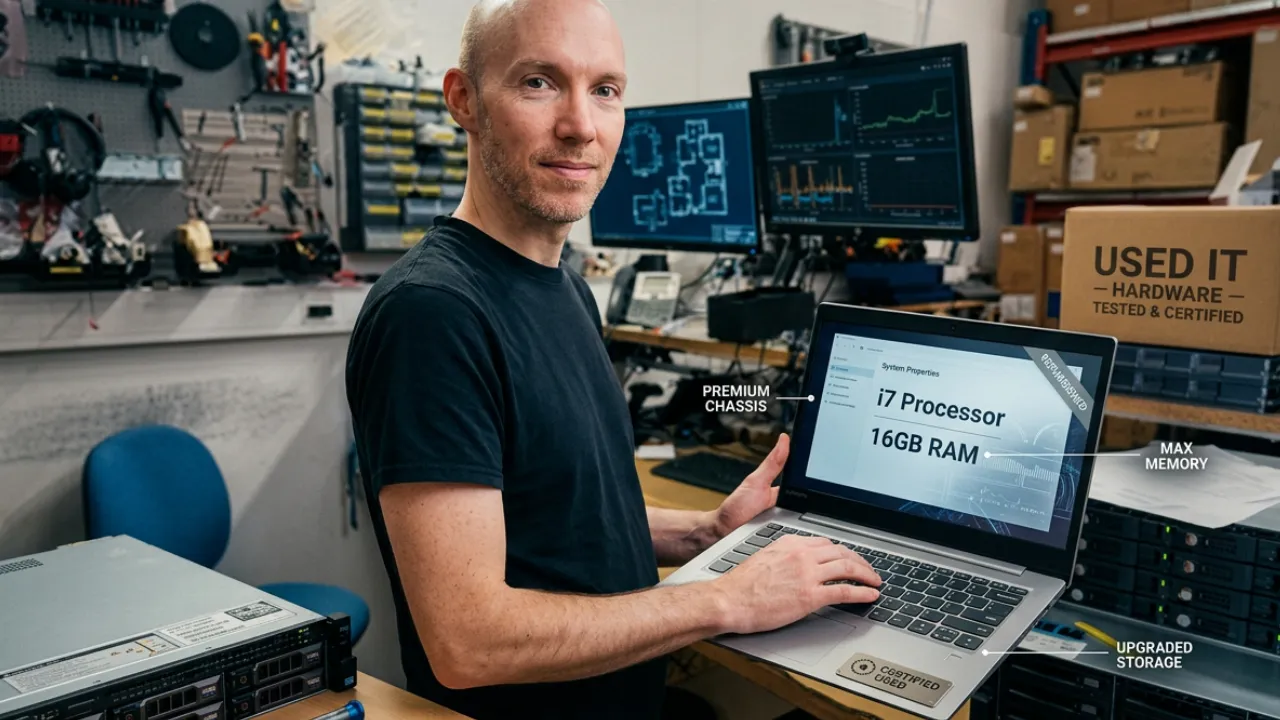

For a long time, there has been a fairly simple logic when companies buy computers: when equipment starts to feel old, you buy new. But as both economic and environmental issues have gained more importance, many organizations have begun to rethink.
Today, the market for refurbished computers is growing rapidly. These are professional IT equipment that has been used in the past but has undergone rigorous inspection, upgrade and quality testing before being sold again.
What Does Refurbished Really Mean?
The term refurbished is often used a bit carelessly, but in practice it means that a computer has been refurbished and quality-assured before it is sold again.
Unlike a regular used computer, refurbished usually means that:
• The hardware has been tested and checked
• Components such as SSD or RAM may have been upgraded
• Operating system reinstalled
• The computer is cleaned and functional tested
The result is a computer that works the same as a new one — but at a significantly lower price.
This is also why refurbished has long been common in larger organisations and public sector organisations where they work more systematically with IT lifecycles.
Professional business computers are built for long life
A major reason why refurbished works so well is that many business computers are built for significantly longer use than they often get. Models from manufacturers such as Lenovo, HP and Dell are designed for daily operation in work environments, with robust components, better cooling and often easy memory and storage upgrades.
In practice, this means that a computer that has been in use for three or four years often still has many stable years of work left, especially after it has undergone service and updating. This makes refurbished a realistic option for many types of operations.
Sustainability that can actually be counted on
Another strong driving force behind refurbished is sustainability. The manufacture of new electronics is resource-intensive and accounts for a large part of a computer's overall climate impact. By extending the life of existing equipment, it reduces the need for new production and the amount of electronic waste.
This is why the reuse of IT equipment has become an important part of many organizations' work with sustainability goals and The 2030 Agenda. In practice, it is about viewing IT equipment as a resource with a longer life cycle, rather than something that is replaced as soon as the next generation is launched.
Local management and quality are crucial
For businesses, it can be crucial to have a partner who not only supplies equipment, but can also help with the entire installation, operation and lifecycle management process. It will be a way to work longer term with IT, from purchasing to reuse and recycling. See more here
When are refurbished computers best suited?
Refurbished computers work particularly well in organizations where many users have relatively similar work needs, such as administrative workplaces, schools and educational environments, municipal operations, and companies with many office workplaces.
For more specialized tasks such as heavy graphic production or advanced development, new hardware may still be the right choice. But for the majority of office work, the performance of a refurbished business computer is more than adequate.
Want to know more about refurbished computers?
At Compliq, we work with quality tested used computers for companies and organizations in Skåne. Read more about how our refurbished solutions work here: www.compliq.se/tjanster/used computers

.jpg)